


Ethereum is the largest player in the entire DeFi ecosystem, having the highest Total Value Locked (TVL) of all blockchain networks.

The entire network is gearing towards its biggest change yet, which is often called The Merge.
Here’s everything you need to know about this game-changing update to Ethereum’s network.
What is The Merge on Ethereum?
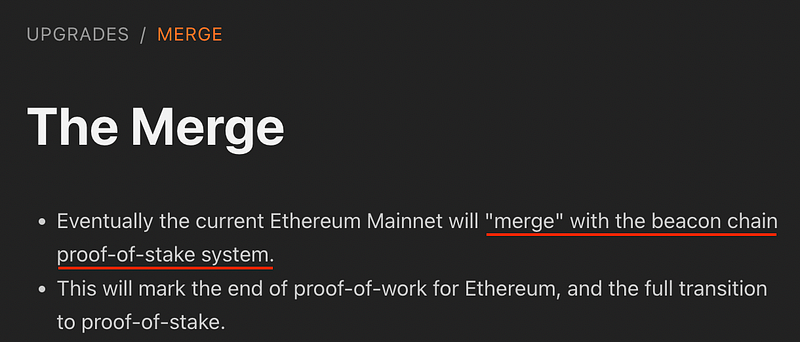
The Merge refers to Ethereum transitioning from Proof-Of-Work to Proof-Of-Stake, where the current Ethereum Mainnet will merge with Ethereum’s Beacon Chain.
Currently, there are 2 main layers on Ethereum:
- Consensus Layer (Beacon Chain)
- Execution Layer (Ethereum Mainnet)
The Beacon Chain was launched on 1st December 2020, and it utilises Proof-Of-Stake.
However, it does not process transactions or handle smart contract interactions.
Meanwhile, the Ethereum Mainnet is the Execution Layer, on which all applications and protocols are operating on. While it has smart contract capabilities, it still uses a Proof-Of-Work consensus mechanism.
Since these are currently 2 separate chains, The Merge intends to bring these 2 layers together, such that the Execution Layer uses Proof-Of-Stake.
Proof-of-Work vs Proof-of-Stake
These are the 2 main types of consensus mechanisms that most blockchain networks use to ensure that transactions are confirmed.
Proof-of-Work (PoW) was first introduced with Bitcoin, and it requires miners to use computer processing to solve a complex puzzle.
Proof of work 💡💸💰 pic.twitter.com/Cnj2gUnOWz
— Asharib Ali 🎯 (@0xAsharib) June 20, 2022
However, there has been a lot of ‘controversy’ regarding POW, particularly due to its environmental impact.
As more miners compete for the block reward, the puzzle becomes more complex and requires more computing power to solve it. This results in a lot of ‘wasted energy’ spent by the miners who do not receive the block reward.
However, there are some contrary beliefs to this claim, and there was a report that Bitcoin is more ‘green’ compared to the traditional finance sector!
Enter, Proof-of-Stake (PoS). A variety of different networks already use this consensus mechanism, including Cardano, Solana and NEAR.
This is an improvement to the PoW consensus in terms of:
- Energy efficiency
- Lower barriers to entry
- Reduced risk for centralisation
In fact, Ethereum has aimed to use the PoS consensus mechanism from the start. However, that was still in the early stages of crypto, and they did not want to sacrifice the security and decentralisation of the network.
How PoS works for Ethereum
With the PoW mechanism, it usually means that the miners with the highest computing capabilities will win.
This is usually done by investing in more powerful hardware to be able to get the block reward.
With PoS, miners are replaced by validators, who have to stake at least 32 ETH, which serves as collateral to ensure that they ‘behave properly’ and do not perform malicious activities that could harm the network.
The stake will be ‘destroyed’ if the validator is deemed to have behaved “dishonestly or lazily”, or if they are offline.

Validators perform the same functions as a miner, including:
- Storing data
- Processing transactions
- Adding new blocks to the Ethereum network
While 32 ETH can be a huge sum, you can delegate your stake to a validator and still earn rewards.
There are roughly 404,000 validators, and the current APY is around 4.2%.

How does The Merge impact Ethereum?
Here are the 6 main factors that The Merge will impact Ethereum:
#1 Environment
The environmental impact of cryptocurrencies has been a huge topic, particular with the PoW mechanism.
"The way proof-of-work works is not sustainable for the environment, unless we do a massive shift," says @WainsteinM of @Open__Earth, discussing their #CarbonDrop NFT auction that raised $6.6 million.
Watch the full discussion, presented by @NexoFinance: https://t.co/Q2X0QdM6kK pic.twitter.com/BoURuFvBA7
— CoinDesk (@CoinDesk) January 7, 2022
With more miners competing for the block reward, the puzzle to solve becomes more complex, resulting in miners requiring more computing power and in turn, consumes much more energy.
Ethereum claims that the energy consumption on the network will decrease by ~99.5% after transitioning from PoW to PoS.
#2 Decentralisation
If you wanted to be a miner for Ethereum, you would need to have invested a huge amount of money into creating your very own mining rig to compete with other miners.
With the switch to PoS, there will no longer be an ‘arms race’ to be able to solve the puzzle.
Now, you no longer need a complex mining rig, and you can run the validator node on a laptop or other low-power devices!
Since the barrier to entry is now much lower, it could lead to even more decentralisation, as there will be more validators that are securing the network.
However, there are also fears that Ethereum could become more centralised too.
This is because Lido Finance, a platform that provides liquid staking of ETH, controls over 32% of the total amount of staked ETH.

This means that the amount of staking power could be concentrated with Lido, which in fact could make Ethereum a centralised network!
Here was the proportion of ETH that was staked on Lido Finance in April 2022.
Current #Ethereum Staking distribution.
Lido ~3 Mio ETH
Coinbase & Kraken ~ 1 Mio ETH
Binance ~ 600K ETH(Thanks to @nansen_ai for keeping track of validator addresses) pic.twitter.com/iBkQiwnZ4a
— Holger (@rohmeo_de) April 6, 2022
Lido Finance had the highest proportion, followed by Coinbase, Kraken and Binance. All of these are centralised entities.
However, the staked ETH is spread between 29 different node operators.
12/ "So it's true that Lido has 32% of staked $ETH, but it consists of 29 different node operators."
Hasu believes liquid staking derivatives in DeFi have a very strong network effect, such that if you want to stake your ETH, you would always choose the largest provider.
— The Defiant (@DefiantNews) June 29, 2022
The Lido community recently rejected a proposal to limit the amount of ETH that is being staked with them.
After four days of voting, more than 99% of $LDO voters have chosen not to self-limit protocol growth 🗳️
The recent proposal was made to address whether @LidoFinance should be limited to a fixed percentage of $ETH stake.@aleks_gilbert reports 🔗👇https://t.co/m6V7Opqu3u
— The Defiant (@DefiantNews) June 28, 2022
There could be risks of centralisation, and it is something to look out for in the future.
#3 Security
Security is a top priority in a blockchain network, and Ethereum is arguably the most secure network out there.
With ETH being staked with validators, a hacker would need to control a large number of validators to perform any malicious activity.
There is the concept of a 51% attack where a hacker who controls at least 51% of the blockchain could possibly be able to destroy the network if he wanted to!
Ethereum mentions that it is still possible to perform a 51% attack, although monetarily wise, it’s not that possible.
We need to get past the myth that it's *fatal* if one entity gets enough to 51% attack PoS. The reality is they could attack *once*, and then they either get slashed or (if censorship attack) soft-forked away and inactivity-leaked, and they lose their coins so can't attack again. https://t.co/utash1hUDU
— vitalik.eth (@VitalikButerin) September 2, 2020
PoS adds even more security, and you can check out this video here which provides a great explanation:
#4 Deflationary pressure
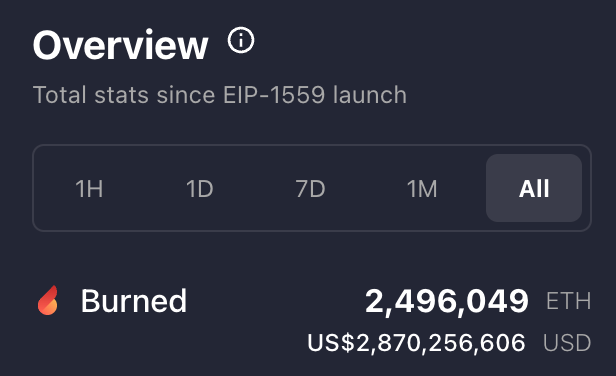
The EIP-1559 upgrade introduced a burning mechanism to Ethereum. When a transaction is executed, the base fee will get burned, where that amount of ETH will be removed from the total circulating supply.
Since the launch, over 2 million ETH has already been burnt.
On the flip side, ETH is also being issued, where new ETH is being created and enters the circulating supply.
With the move to PoS, the Ethereum network no longer to issue ETH to miners.

The only amount of new ETH issued will be to validators on the Consensus layer (i.e. Beacon Chain).
As a result, it is expected to have a net annual reduction in ETH issuance by ~89.4%.

Previously, the annual issuance rate was 4.62%, and will drop to 0.49% once The Merge happens.
The ETH community has termed this as the ‘Triple Halvening’, due to this huge decrease in ETH issuance.
Both of these factors will play a part in reducing the circulating supply of ETH:
- More ETH is being destroyed by burning
- Less ETH being issued (created) and introduced into the circulating supply
With an overall decrease in ETH supply, it is expected to result in deflationary pressure on the price of ETH.

#5 Scalability
You may have heard of the rather exorbitant gas fees when transacting on the Ethereum network, which can cost a few dollars per transaction.
This is in contrast to other blockchains like Solana or Fantom, where the gas fees only cost a few cents!
The main reason why fees are high on Ethereum is that it is the most popular blockchain, with a maximum of 1,716,600 transactions per day.

There are more transactions than what can be included in each block, so you will need to pay higher gas fees for your transaction to be processed.
You can find out more about the EIP-1559 upgrade here, which helps to give a better gauge on the amount of gas fees that you pay.
Currently, Ethereum only has a tps of around 10, which pales in comparison to the newer blockchain networks.
Currently, Ethereum is relying on Layer 2 solutions to scale applications on the network.
Some Layer 2s include Polygon, Arbitrum and Optimism, where they take the transaction load off Ethereum, such that there are lesser transactions on Ethereum, which should lead to lower transaction fees.
You can use the Polygon and Arbitrum networks on Krystal for all of your DeFi needs.
🔥 Krystal now supports DeFi services on @arbitrum 🔥
👉 Token Swaps are available via SushiSwap, stay tuned as we will add more DEXes and SmartSwap on #Arbitrum in the future! 🤩
👉 Swap here on Arbitrum: https://t.co/6thr7ZlIGL👀 Drop us a COMMENT if you love it, mates! pic.twitter.com/xhelbuNukd
— Krystal DeFi (@KrystalDefi) April 7, 2022
However, this does not fundamentally change the Ethereum network, as the gas fees still remain much higher than other networks.

With the switch from PoW to PoS, Ethereum will now have the capability to perform sharding.
Sharding splits up and delegates different network responsibilities to each validator.
In fact, Ethereum aims to have 64 shards after the upgrade, which is much higher compared to other networks like Harmony, which only has 4.
Due to the PoS mechanism, validators are required to leave their nodes on at all times, or they will be penalised. Furthermore, all of these validators would be able to be identified, since all of them will have ETH staked.
Having a list of all validators who are constantly contributing to the network will be useful as tasks can be delegated to each one.
This is in contrast to PoW miners, who can turn off their mining rig at any time. Furthermore, it is much harder to obtain a list of all miners that are contributing to the network.
Ultimately, sharding helps to make the Ethereum network much more efficient.

As a result, Ethereum should be able to increase its transactions per second (tps) capability, which could most probably lead to much lower gas fees.
Sharding, on the other hand, increases the capacity of the base layer by ~100x. This could lead to a 100x decrease in fees, though realistically in the long term it would not decrease quite as much because people's interest in using ethereum (ie. demand) would also increase
— vitalik.eth (@VitalikButerin) September 2, 2020
As such, The Merge does not reduce gas fees.

Instead, The Merge provides the infrastructure needed for sharding, and it will be sharding that reduces gas fees by enabling Ethereum to process more transactions.
Sharding is only expected to arrive in 2023, so it will still take a while before those gas fees become lower!

In fact, Ethereum aims to be the infrastructure for different Layer 2s to be built on top of it, also known as a modular blockchain.
How does The Merge impact me?
If you are a user of the Ethereum network, you do not need to do anything.
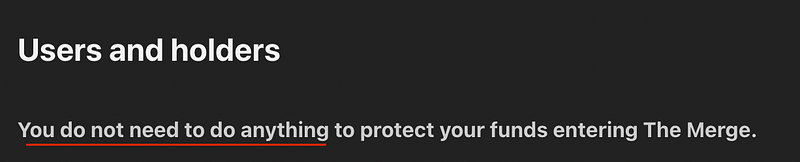
The Merge will be done in the background, and even if it changes from PoW to PoS, nothing much will really change on the user’s end.
In contrast, node operators and DApp developers may need to make some tweaks to prepare for The Merge.
Why is The Merge taking so long?
The Merge has been announced quite some time ago, and it has been delayed a few times.
It won't be June, but likely in the few months after. No firm date yet, but we're definitely in the final chapter of PoW on Ethereum
— timbeiko.eth (@TimBeiko) April 12, 2022
Tim Beiko is one of the developers of Ethereum, and you can follow him for more updates on The Merge.
One of the main reasons why The Merge is taking so long is that there are already many users and protocols that are on the network.
Since they all depend on the network to function, The Merge has to be done smoothly and without any hiccups.
Any bugs or errors could lead to a huge impact on the billions that are being locked up in the network!
As such, a lot of testing needs to be done by the developers to ensure that The Merge is perfect.
This is also why PoS can’t be launched on the Mainnet straight away.
The Merge has already been done on various testnets, such as Ropsten, which is a public testnet.
We're back with the eth2 updates! In the past month:
• Ropsten testnet merged successfully
• Difficulty bomb delayed until September; Merge expected late Aug-Nov
• Beacon Chain experienced an unlucky reorgDive into the full update 👇https://t.co/v7JLTBv3gI
— Coinbase Cloud (@CoinbaseCloud) June 28, 2022
However, Ethereum will need to be deployed on 2 more public testnets (Sepolia and Goerli) before it can be launched on the Mainnet.
With the new blockchain system responding well on the Ropsten testnet, Sepolia can be seen as a critical challenge for @ethereum to decide how The Merge will be implemented.#crypto #CryptoNews #Cryptocurrencies #DeFi #Ethereumhttps://t.co/k2I3vxbsJi
— BSC News (@BSCNews) June 28, 2022
Difficulty bomb delay
During the Ropsten launch, the developers noticed some bugs, and they have decided to delay the difficulty bomb to give more time to fix these issues.
A difficulty bomb exponentially increases the difficulty of the puzzle, making it much harder to mine ETH via PoW.
This is done to encourage miners to ditch PoW in favour of PoS.
The Gray Glacier update was announced which will delay the difficulty bomb by approximately 100 days.
Friendly reminder
There's an Ethereum network upgrade (hard fork) called Gray Glacier happening at block 15,050,000 (expected on June 29th) that will delay the difficulty bomb by 700,000 blocks.
Please upgrade your nodes!!
Full details 👇https://t.co/xwE7oBR4Xz
— sassal.eth 🦇🔊 (@sassal0x) June 20, 2022
As such, it could still be a while before The Merge is finally complete, which is expected around Q3 or Q4.
Conclusion
The Merge is a much-needed upgrade to Ethereum, and it lays out the infrastructure for Ethereum to become more secure, scalable and environmentally friendly.
While The Merge seems to keep delaying, it seems that the devs want to make sure that everything is perfect before they release it on the Mainnet!
🔍 Navigate the DeFi Space now with Krystal!
Start your journey NOW on Desktop, iOS or Android
📱 Social Media
- Follow us on Telegram:
Announcements | Krystal Global | Krystal Vietnam 🇻🇳| Krystal Russia 🇷🇺 | Krystal Korea 🇰🇷 | Krystal Turkey 🇹🇷 | Krystal Africa 🌍 | Krystal Indonesia 🇮🇩 | Krystal India 🇮🇳 | Krystal Bangladesh 🇧🇩 - YouTube


