


The crypto markets have been really volatile, and the Terra ecosystem has taken a huge hit.
Not long after overtaking BUSD as the #3 stablecoin, UST has started to lose its peg to the US Dollar.
Here’s an explanation of what happened to this stablecoin:
What is an algorithmic stablecoin?
Algorithmic stablecoins use code to maintain their peg to the US dollar. These programs will encourage traders to maintain the peg to 1 US dollar whenever the stablecoin is above or below 1 USD.
In the case of UST, 1 UST is minted (or created) whenever $1 USD of LUNA is burned.
Just a reminder on how $UST works:
You can always redeem $LUNA for $UST dollar-for-dollar, and vice versa.
If $LUNA is at $50, you can redeem it for 50 $UST.
Similarly you can redeem 50 $UST for 1 $LUNA.https://t.co/DAGmnXrdM4
— jonwu.eth (@jonwu_) May 9, 2022
When UST drops below $1 USD, traders can burn 1 UST (i.e. remove 1 UST from circulation) to exchange for $1 USD worth of LUNA. This will reduce the supply of UST, which in theory should increase its price.
When UST is greater than $1 USD, traders can burn $1 USD of LUNA and receive $1 UST. This will increase the supply of UST, and in theory, it should decrease UST’s price.
Before this recent de-pegging of UST, there were only 2 occasions when this stablecoin lost its peg: December 2020 and May 2021.
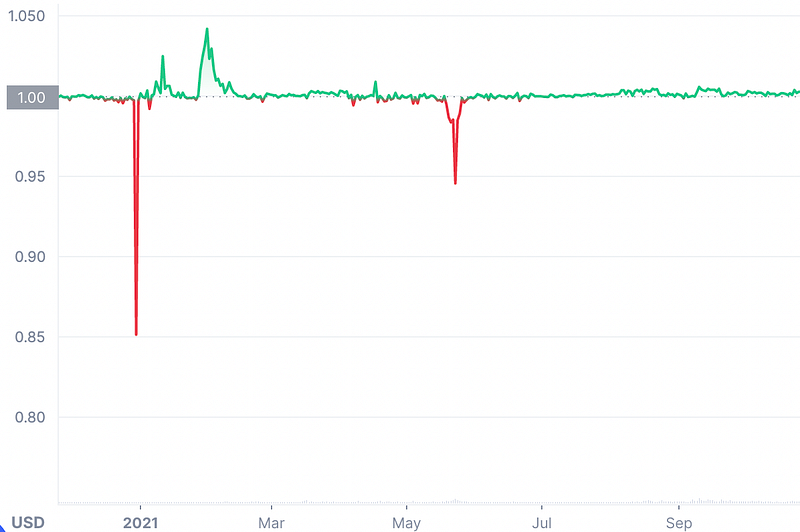
This is different from asset-backed stablecoins like USDT and USDC. In theory, for every USDT and USDC minted, there should be 1 USD in Tether’s or Circle’s reserves.
However, in reality, this may not always be the case.
For example, in a July 2021 audit done by Grant Thornton on USDC, it was found that only 61% of USDC’s reserves were in cash or cash equivalents!

Algorithmic stablecoins attempt to make the stablecoin more decentralised, where the peg is not maintained by a centralised entity.
Is the peg really stable?
While the peg has been rather stable, market volatility has affected it in the past.
The LUNA Foundation Guard (LFG) was created to protect the peg during such volatile times, by deploying certain funds that it has in its reserves.
The @LFG_org is creating a #Bitcoin reserve to defend the peg of @terra_money stablecoins like $UST.
The question is: How does it work & what effect will it have on $LUNA, the Terra ecosystem, or even $BTC?
Let´s check the governance proposal by @jump_ & make a deep dive 👇🧵/n pic.twitter.com/JGvgxLQfHU
— danku_r (@danku_r) March 30, 2022
LFG has been buying up multiple assets for its reserve, including BTC,
1/ The LFG has acquired an additional 37,863 Bitcoins totaling ~$1.5 billion in OTC swaps with @GenesisTrading and 3AC. https://t.co/Ezzfwl7VFn
— LFG | Luna Foundation Guard (@LFG_org) May 5, 2022
and AVAX.
Welcoming $AVAX as the second major layer one crypto asset next to $BTC as part of the $UST Reserve.
The inclusion of @avalancheavax's native token marks the start of a diverse pool of layer one crypto assets helping support the $UST peg.
It's only just the beginning frens. https://t.co/5utdQMVAiw
— LFG | Luna Foundation Guard (@LFG_org) April 7, 2022
You can view their entire reserves on this page.
How did UST lose its peg to USD?
The true cause of UST losing its peg is still unknown. There have been rumours that it could have been a coordinated attack, but that is still yet to be confirmed.
today's attack on Terra-Luna-UST was deliberate and coordinated. Massive 285m UST dump on Curve and Binance by a single player followed by massive shorts on Luna and hundreds of twitter posts. Pure staging. The project is bothering someone. 🌝 on the right path!
— Caetano Manfrini 🔺 (@caemanfrini) May 8, 2022
Some large firms like Citadel and BlackRock have been accused of orchestrating this attack. However, both of them have denied any involvement.
We are aware of a recent story that suggested Gemini made a 100K BTC loan to large institutional counter-parties that reportedly resulted in a selloff in $LUNA. Gemini made no such loan.
— Gemini (@Gemini) May 11, 2022
Nevertheless, here’s a breakdown of some of the factors that could have led to UST depegging from USD.
#1 ‘Unsustainable’ yields by Anchor
The Anchor Protocol has been extremely popular with its promise of double-digit yields for depositing UST.
While this has led to a huge inflow of cash into the Terra ecosystem, the yield is considered to be unsustainable.
As Anchor’s TVL grows (currently at a staggering 19.4B $UST), it’s increasingly more important for the community to come together to discuss & debate impactful decisions around both the Earn & Borrow sides of the protocol.
Join us tomorrow to discuss semi-dynamic Earn rates 👇 https://t.co/5AaICnKV5y
— Anchor Protocol (@anchor_protocol) April 27, 2022
Anchor recently reduced its rates from 19% to 18.5%.
1/ As discussed in this last week’s semi-dynamic Earn rate AMA, the Earn rate will update today, May 1st, to exactly 18% APY @ 12pm EST.
Let’s recap some of the details around the semi-dynamic Earn rate 🧵
For a more detailed view into the new rate, check out this thread 👇 https://t.co/xUUzgC7kwI
— Anchor Protocol (@anchor_protocol) May 1, 2022
With this increase in popularity of the Anchor Protocol, it has led to a huge demand for UST.
#2 Launch of 4-pool on Curve Finance
It appears to have started when the 4-pool was launched on Curve Finance.

This is a liquidity pool on Curve Finance, and it contains 4 stablecoins (2 asset-backed and 2 algorithmic):
- USDC (asset-backed)
- USDT (asset-backed)
- UST (algorithmic)
- FRAX (algorithmic)
1/ Introducing the 4pool – between @fraxfinance, TFL and @redactedcartel we pretty much own all the cvx
UST-FRAX-USDC-USDT
Curve wars are over, all emissions are going to the 4pool https://t.co/LNJs7CAfcV
— Do Kwon 🌕 (@stablekwon) April 1, 2022
On Curve Finance, you are able to deposit stablecoins into this pool, and earn rewards whenever a user makes a trade in the pool.
If newer stablecoins UST and FRAX can be traded 1:1 with more established coins (USDT and USDC), this will help to increase the legitimacy of these 2 algorithmic stablecoins.
Terra co-founder, Do Kwon, mentioned that he wanted to ‘starve the 3-pool’, which is a liquidity pool that contains 3 stablecoins: USDT, USDC and DAI.
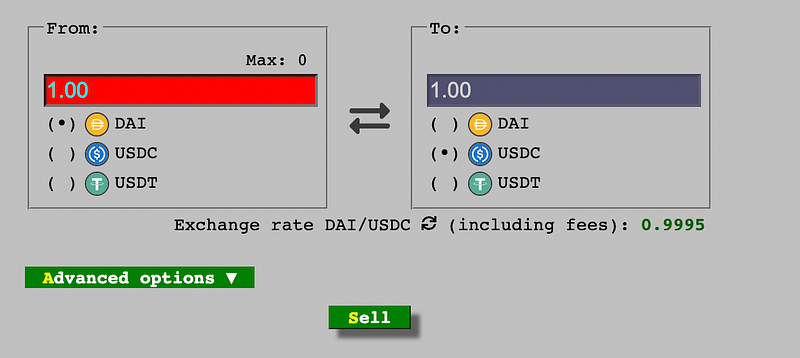
This 3-pool has extremely high liquidity on Curve Finance, around $2.7 billion.
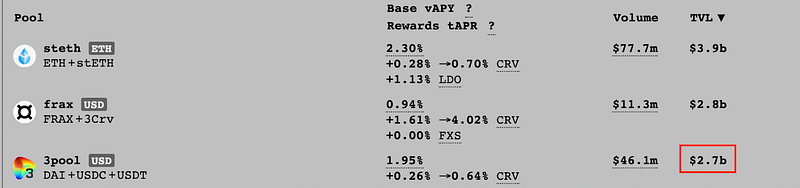
By offering greater rewards on 4-pool, it was hoped that liquidity would be shifted from 3-pool to 4-pool.
By my hand $DAI will die.
— Do Kwon 🌕 (@stablekwon) March 23, 2022
#3 Liquidity from UST was removed from Curve
In preparation for this 4-pool, about 150M worth of UST was removed from Curve Finance.
– We removed 150M UST from Curve to get ready to deploy into 4pool next week
– 84M dump not us – lmk if you find out who
– After the imbalances started to happen, we removed 100M UST to lessen the imbalanceObv TFL has no incentive to depeg UST
— Do Kwon 🌕 (@stablekwon) May 8, 2022
However, there was an $84M dump of UST, which is suspected to have been someone taking advantage of this reduced liquidity.
UST fiasco is very fishy.
– Terraform Labs removed $150m of UST liquidity from Curve yesterday
– 1 minute later, a freshly funded address bridged $84m of UST to Ethereum (Initiated bridging before TFL removed liquidity)
– 4 min later, it dumped the UST, triggering the sell-off— Mudit Gupta (@Mudit__Gupta) May 8, 2022
This $84M of UST was sold for Ethereum. A huge increase in the supply of UST in the market led to a decrease in UST’s price.
#4 A vicious spiral continued
Due to the fear of this depegging, there have been large withdrawals from the Anchor Protocol.
There has been a huge sum of withdrawals, where the amount of UST reduced from $14 billion (May 6) to $1.7 billion (May 13).
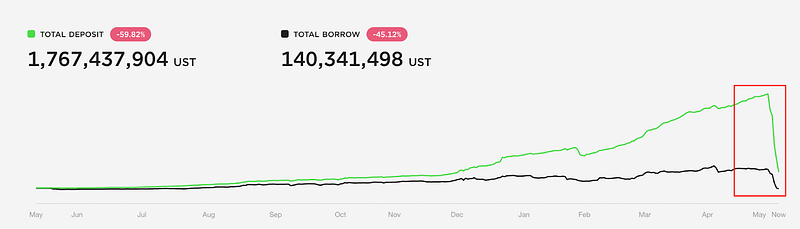
The number of withdrawals could also have been due to the lowering of Anchor’s yield.
With so much UST in circulation, it has made things much worse!
Fear, uncertainty and doubt (FUD) have been widespread, and many people are desperate to get out of UST before it’s too late.
Due to this huge sell-off pressure, it could have prevented the price of UST from rising back to 1 $USD.
#5 Widespread adoption of UST may have caused problems
With UST rising in popularity, many exchanges have started to list this stablecoin.

However, it was mentioned that the on-chain peg for UST never deviated.
A very important note about this is that the true peg, the on-chain peg, never deviated during all of this market madness. On ETH-based swaps, yes, there was a deviation and this is exactly why the mystery wallet had to bridge to make these swaps. https://t.co/i1eieIlKOI https://t.co/OFMS6O7iC2 pic.twitter.com/qW6IyxFlHo
— jack (@forgash_) May 9, 2022
This could mean that the Mint and Burn mechanism of LUNA and UST may no longer be able to maintain the peg, due to UST’s widespread circulation.
What has been done to fix the de-pegging?
Here are some of the corrective measures that were taken to restore UST to its original peg.
#1 Utilisation of LFG’s BTC reserves
The LFG loaned out $750 million worth of BTC and $750 million worth of UST to help stabilise the markets.
1/ The LFG Council just voted to deploy 1.5B in capital (0.75B in BTC, 0.75B in UST) to allay market concerns around UST. Some more context on why and how: https://t.co/TfaAPkzgUJ
— Do Kwon 🌕 (@stablekwon) May 9, 2022
However, this did not bring up the peg back to $1 USD as expected.
Selling the treasury BTC was a mistake.
The battle was already lost, and needed all the collateral available to survive to another day.
— mhonkasalo (@mhonkasalo) May 9, 2022
Furthermore, with such a huge inflow of BTC back into the market, it could further worsen the market crash that we are experiencing right now.
#2 Increase minting capacity of LUNA
On 11th May, Terraform Labs CEO Do Kwon laid out his plans to bring UST back to the peg.
He supported a proposal to increase the minting capacity of LUNA by 4 times, to allow UST holders to cash out.
7/ First, we endorse the community proposal 1164 to Increase basepool from 50M to 100M SDR *) Decrease PoolRecoveryBlock from 36 to 18 This will increase minting capacity from $293M to ~$1200M. https://t.co/aqNKzYK2xC
This should allow the system to absorb the UST more quickly.
— Do Kwon 🌕 (@stablekwon) May 11, 2022
This will essentially increase the supply of LUNA by a huge proportion, and as a result, the price of LUNA may plummet.
As such, it seems that Do Kwon may be sacrificing the price of LUNA to stabilise the peg.
It remains to be seen if this strategy works. At the current time of writing, UST is way below its peg.

What goes on from here?
Things are looking extremely bleak for the entire Terra ecosystem, and all this while, Do Kwon has remained silent.
LUNA and UST are starting to be delisted from the major exchanges,
Updates:
🔸Notice of removal of some margin and spot trading pairs at 12:40am UTC, May 13, 2022.
🔸Adjusting of tick size for spot trading pair at 12:40am UTC, May 13, 2022. https://t.co/jijqNqaTdJ— Binance (@binance) May 13, 2022
and the Terra blockchain has already been halted twice.
The Terra blockchain has officially halted at block 7607789.
Terra Validators have halted the network to come up with a plan to reconstitute it.
More updates to come.
— Terra 🌍 Powered by LUNA 🌕 (@terra_money) May 13, 2022
We still don’t know for sure what the solution will be, but we hope that a solution can be carried out to save the Terra ecosystem.
What can other stablecoins do to reduce such risks?
With 2 new algorithmic stablecoins recently being launched (USN on NEAR and USDD on Tron), it will definitely be interesting to see how these projects react to this event, and what measures they will take.
Could this depegging be due to UST blowing up and expanding too fast?
For example, one of the most apparent issues is that the rapid growth and proliferation of UST has increased peg vulnerability off-chain. Protecting UST just on Terra is not enough anymore, we need to protect it everywhere it has liquidity.
— White Whale (@WhiteWhaleDefi) May 10, 2022
USDD is promising a 30% return on their USDD stablecoin. Since it looks eerily similar to UST, this may prompt TronDAO to rethink how they would ensure USDD’s sustainability.
What does this mean for you?
There have been many factors that resulted in this debacle, and most of them are out of our control.
The confidence in the Terra ecosystem has definitely been shaken, and UST may no longer be the ‘safe haven’ as we once thought it was.
For everyday investors like us, this serves as a stark reminder that no investment is ‘risk-free’, and it is always important to fully understand the risks before going into any project.
Are you holding UST, or selling it off? What do you think about the future of the Terra ecosystem?
Let us know in the comments below!
Navigate the DeFi Space now with Krystal!
Social Media
- Follow us on Telegram:
Announcements | Krystal Global | Krystal Vietnam 🇻🇳| Krystal Russia 🇷🇺 | Krystal Korea 🇰🇷 | Krystal Turkey 🇹🇷 | Krystal Africa 🌍 | Krystal Indonesia 🇮🇩 | Krystal India 🇮🇳 | Krystal Bangladesh 🇧🇩 - YouTube


